
Former Brazil player and manager Mario Zagallo dies at the age of 92
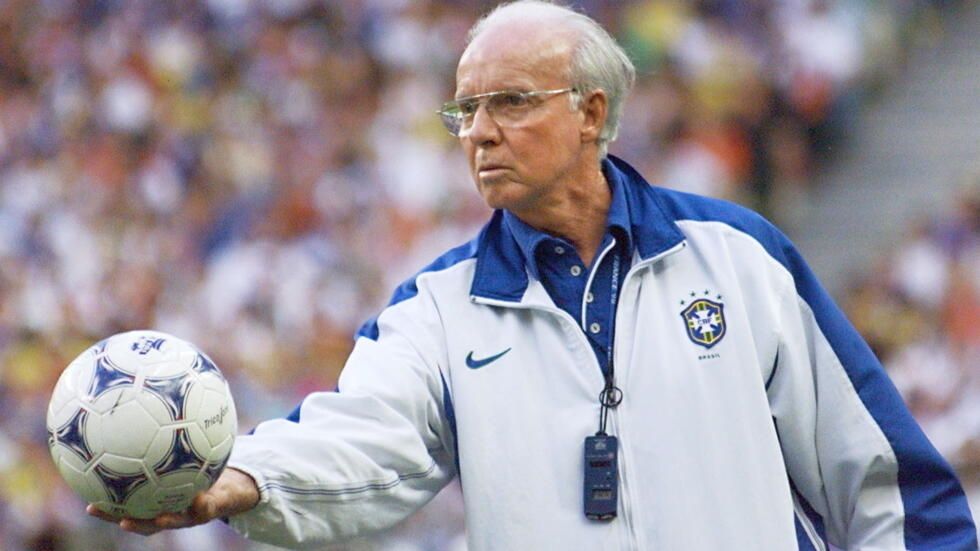
Zagallo, a skilled and resilient left winger, was a key player in Brazil's victorious team during the 1958 World Cup, and he maintained his position in the squad that successfully defended the title four years later.
In 1970, he took on the role of coach for Brazil, leading a squad that included legendary players such as Pele, Jairzinho, Rivellino, and Tostao. Many consider this team to be the greatest national team in the history of the sport. Together, they secured Brazil's third World Cup victory in Mexico.
This remarkable achievement made Zagallo the first individual in the sport to win a World Cup both as a player and as a manager.
Later on, he served as an assistant coach to Carlos Alberto Parreira when Brazil triumphed in their fourth World Cup title in 1994, held in the United States.
Zagallo's idiosyncratic personality and unwavering patriotism endeared him to his Brazilian fans. He proudly proclaimed that victory was ingrained in his very being and fearlessly challenged those who criticized his teams for being too defensive.
One of his most memorable moments occurred after Brazil's triumph in the Copa America in Bolivia in 1997. Despite being underestimated, Zagallo's team emerged victorious, and an impassioned Zagallo, his face flushed from the high altitude of La Paz, passionately exclaimed into the television cameras, "You're going to have to tolerate me!"
This phrase continues to be frequently echoed by Brazilians from all walks of life, celebrating their vindication.
Zagallo was also renowned for his strong superstitions, particularly his belief in the lucky power of the number 13. He delighted in crafting phrases containing exactly 13 letters, chose to marry on the 13th day of the month, and even playfully joked about retiring from the game at precisely 13:00 on July 13, 2013.
Mario Jorge Lobo Zagallo, known as the Old Wolf, was born on August 9, 1931, in Maceio on the impoverished north-eastern coast of Brazil. His family relocated to Rio de Janeiro before his first birthday, and it was there that he developed a passion for football.
Initially, Zagallo aspired to become an airline pilot, but his poor eyesight prevented him from pursuing that career path. Instead, he studied accountancy and played football in his free time for the local team America, one of the prominent clubs in the city.
In an interview published by the Brazilian Football Confederation (CBF), Zagallo revealed, "My father didn't want me to be a football player, he wouldn't let me. Back then, it wasn't a respected profession, and society didn't view it favorably... That's why I believe football entered my life by chance."
Zagallo began his football journey as a left midfielder, wearing the number 10 jersey, which, at that time, did not hold the same significance it does today, before Pele popularized it. However, he soon realized that he was in the wrong position at the wrong time.
"I realized it would be difficult to secure a place in the Brazilian national team as a number 10, considering the abundance of talented players in that position," he explained. "So, I made the switch from left midfield to left wing."
He also transferred from America to Flamengo, where he achieved three Carioca state championship titles. The latter part of his career was spent at Botafogo, the city rivals of Flamengo, where he won two more state titles.
Zagallo's first World Cup experience came in Sweden in 1958, where he played in all six matches alongside Garrincha and a young 17-year-old Pele.
"I was 27, and Pele was 17," he reminisced. "That's why I say that I never played with him, but that he played with me."
Four years later, in Chile, Zagallo became a champion once again, but only after implementing some tactical adjustments. He would drop back to assist in marking the opposing full-back, and when his team gained possession, he would swiftly surge up the wing. This approach of forwards aiding in defense was unconventional at the time, and Zagallo is credited with revolutionizing the role of wingers in the game.
Zagallo, renowned as a coach, had an impressive career leading various Brazilian clubs. However, his defining moment came when he was chosen to replace the controversial Joao Saldanha as the manager of the Brazilian national team just months before the 1970 Mexico World Cup.
At that time, Brazil's performance had been inconsistent, and they were not considered strong contenders. Nevertheless, Zagallo successfully united the team, which consisted of talented players, and culminated in a remarkable 4-1 victory over Italy in the final.
Zagallo continued to manage the national team until 1974, guiding them to a fourth-place finish in West Germany. However, this achievement was overshadowed by a disappointing performance. Subsequently, he went on to manage clubs in Brazil and national teams in the Middle East.
In 1994, Zagallo served as an assistant to Parreira when Brazil secured their fourth World Cup title. He also held the position of head coach in 1998, when Brazil suffered a 3-0 defeat to hosts France in the final, following star striker Ronaldo's health issues just hours before the match. Additionally, he was part of the coaching staff in 2006 when Brazil was eliminated in the quarter-finals.
The 2006 World Cup proved to be a challenging period for Zagallo, as he had been unwell leading up to the tournament. The pressures of management took a toll on him, prompting his retirement from the game.
Despite stepping away from coaching, Zagallo remained a prominent figure in the public eye. He frequently appeared on television, attended prestigious events, and contributed to the Brazilian Football Confederation (CBF).
Zagallo married Alcina de Castro in 1955, and they remained together until her passing in 2012. The couple had four children.
Chris John