
St. Pauli secure promotion and return to the Bundesliga after 13 years
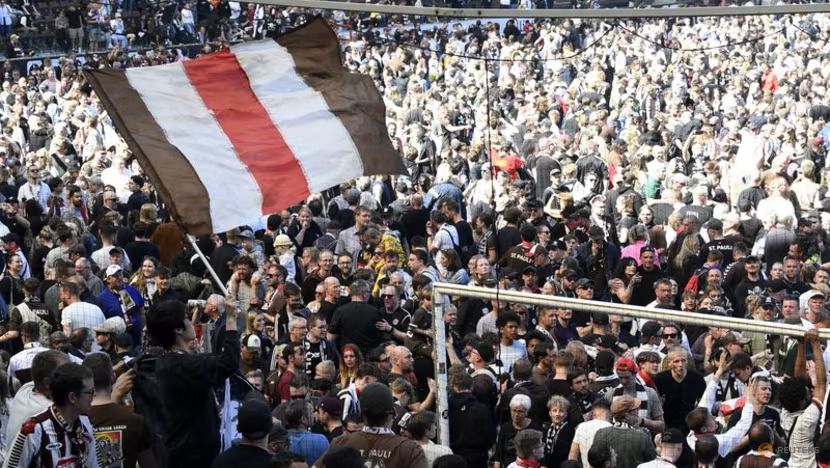
St. Pauli secured promotion to the Bundesliga after 13 years since their last top-division appearance by defeating Osnabruck 3-1. The Hamburg club outperformed their rivals Hamburg SV for the first time in history, earning their sixth promotion to the Bundesliga.
Currently leading the table with 66 points and one game remaining, St. Pauli is one point ahead of Holstein Kiel in second place and six points ahead of Fortuna Duesseldorf in third.
Meanwhile, Hamburg SV sits in fourth place, missing out on promotion once again. The top two clubs secure automatic promotion, while the third-placed club enters a promotion/relegation playoff against the Bundesliga club finishing 16th.
10 things you need to know about the Bundesliga
The German Bundesliga is one of the world’s most exciting football leagues. Known for its passionate fans, affordable tickets, attacking football and incredible stadium atmospheres, it’s a competition that continues to grow in global popularity. Since its launch in 1963, the league has seen legendary players, record-breaking performances, and plenty of drama on and off the pitch.
Here are 10 things you should know about the Bundesliga:
1. Beginnings
Compared to England and Spain, Germany was late to establish a national top division. The Bundesliga’s first season kicked off in August 1963 with 16 clubs. It expanded to 18 teams in 1965/66 and has mostly stuck to that format, except in 1991/92 when 20 clubs competed to accommodate East German teams Hansa Rostock and Dynamo Dresden after reunification.
2. Champions
Cologne were the first Bundesliga champions in 1963/64. The league’s early years saw a variety of winners including Werder Bremen, 1860 Munich and Eintracht Braunschweig. Borussia Mönchengladbach and Bayern Munich soon emerged as dominant forces in the 1970s, trading titles in a golden era. Since then, Bayern have become the undisputed powerhouse, lifting the trophy a record 31 times, including an unmatched 10 consecutive titles between 2013 and 2023.
3. Goal Machines
Gerd Müller remains the Bundesliga’s ultimate scorer with 365 goals in 427 games for Bayern. His record feels untouchable, though Robert Lewandowski came closest with 312 goals before leaving for Barcelona in 2022. Other greats on the scoring charts include Klaus Fischer (268), Jupp Heynckes (220) and Claudio Pizarro (197), who also holds the record as the oldest scorer in Bundesliga history.
4. Goals Galore
If you like attacking football, the Bundesliga delivers. It regularly has the highest goals-per-game average among Europe’s top leagues. For instance, in the 2021/22 season, Bundesliga matches produced 954 goals at 3.12 per game, outscoring the Premier League, La Liga, Serie A and Ligue 1.
5. Youth Development
Nurturing young talent is part of the Bundesliga’s DNA. All clubs are required to run academies under strict DFL licensing rules. At least 12 players eligible for Germany must be included at youth levels (U16 to U19), ensuring a constant pipeline of homegrown talent feeding both the league and the national team.
6. Packed Stadiums
Bundesliga games are famous for their crowds. Affordable ticket prices and safe standing areas mean fans flock to matches in huge numbers. Before the pandemic, average attendances topped 43,000 per game—more than the Premier League and nearly double Ligue 1’s average. Only the NFL has higher average crowds worldwide.
7. The 50+1 Rule
A unique feature of German football is the “50+1 rule.” It ensures that club members (the fans) retain majority voting rights in their clubs, preventing outside investors from taking total control. This system keeps German football rooted in community and tradition, and is one reason supporters feel so connected to their teams.
8. What “Bundesliga” means
The word “Bundesliga” simply means “Federal League.” The “Bundes-” part, as seen in words like Bundestag (parliament) or Bundesrepublik Deutschland (Federal Republic of Germany), indicates its national scope. It’s pronounced “Bun-des-liga,” without any “sh” sound in the middle.
9. Tech Pioneers
The Bundesliga prides itself on innovation. It introduced goal-line technology in 2015 and became the first European league to use VAR (Video Assistant Referee) in 2017/18. These moves highlight the league’s commitment to embracing technology to improve fairness and accuracy in the game.
10. Records and Firsts
The Bundesliga is full of fascinating records:
- Oldest player: Klaus Fichtel, 43 years and six months (Schalke, 1988).
- Youngest player and scorer: Youssoufa Moukoko, debuting at 16 years and one day, scoring at 16 years and 28 days.
- Most appearances: Karl-Heinz “Charly” Körbel with 602 matches, all for Eintracht Frankfurt.
- Fastest five goals: Robert Lewandowski scored five in just nine minutes for Bayern against Wolfsburg in 2015.
- Youngest full-time coach: Julian Nagelsmann, who took over Hoffenheim at just 28 years old.
Chris John