
USA's Lyles wins Olympic 100m gold with closest finish in modern history
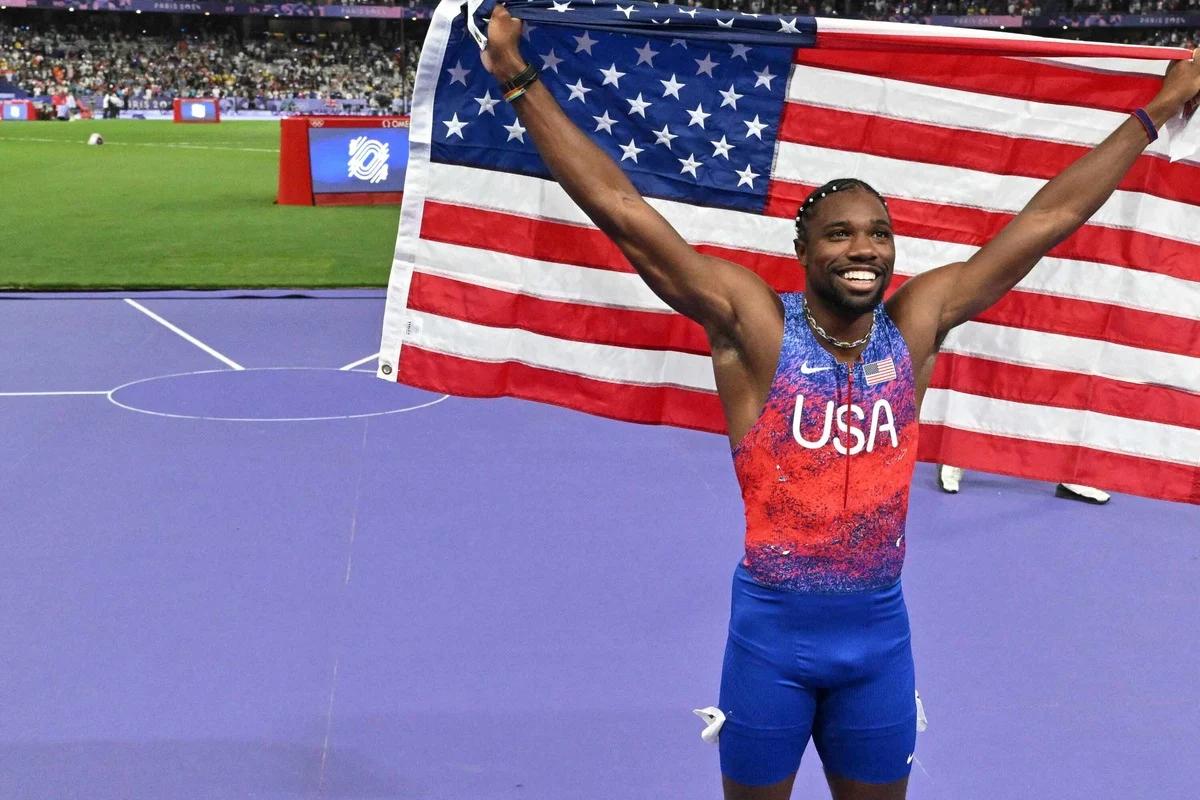
World champion Noah Lyles, aged 27, triumphed in a thrilling men's Olympic 100m final in Paris on Sunday, finishing with a time of 9.79 seconds to secure the gold medal.
This race marked the closest finish in Olympic 100m history, with only five-thousandths of a second distinguishing Lyles from Jamaica's Kishane Thompson, who also recorded a time of 9.79 seconds.
With this victory, Lyles became the first American, regardless of gender, to win this event since Justin Gatlin's gold medal performance at the 2004 Athens Games.
"This is the title I desired," Lyles remarked. "It was a tough competition against remarkable opponents.
"Everyone was in good health and came ready for the challenge, and I aimed to demonstrate that I am the top contender among them. I am the wolf among wolves."
Lyles' win was ultimately validated through a photo finish.
Reflecting on the suspenseful wait for the final results, Lyles shared, "I approached Kishane and candidly told him, 'Honestly, I think you might have won that one.'
"I was fully prepared to see his name appear, and when my name showed up, I was astonished. It feels incredible."
In a thrilling competition, Fred Kerley, Lyles' teammate from the US, secured the bronze medal with a time of 9.81 seconds, narrowly beating South African Akani Simbine, who finished in 9.82 seconds.
The defending champion Marcell Jacobs of Italy crossed the finish line in fifth place with a time of 9.85 seconds, followed by Letsile Tebogo of Botswana in sixth place with a time of 9.86 seconds. American Kenny Bednarek finished seventh in 9.88 seconds, while Jamaican Oblique Seville came in eighth with a time of 9.91 seconds.
Lyles, starting in lane seven, had a decent start and quickly found his rhythm. Despite facing tough competition from the entire field, he managed to maintain his pace.
As Lyles sprinted towards the finish line with Thompson on his heels, the crowd erupted in excitement. A photo-finish was required to determine the winner, with Lyles ultimately being awarded the gold medal.
The Stade de France, filled with 69,000 spectators, was buzzing with energy before the race. A spectacular light show and lively music added to the excitement as the sprinters prepared for the final moments before the starting gun.
The lights went out, and the sprinters exited the track to make their entrance, resembling prize fighters in a colosseum.
Each sprinter was introduced individually with their name and flag displayed.
Thompson let out a roar, his hands clenched in fists as he threw his head back. Kerley patted his heart.
Lyles bounded out like a kangaroo, bouncing 20 meters down the track. Jacobs remained cool, raising both arms and calmly walking to his blocks.
Then came the moment when the sprinters set, at the starter’s beck and call.
The wait seemed endless. The music continued, the crowd clapped in unison as if to hurry the starter, then the sprinters stood in their lanes, rocking from foot to foot and the tension was palpable.
The cameras panned one more time and then it was time, the only sound was that of a helicopter's wings whirring overhead.
The shot was fired and the field moved as if one up the purple track.
The photo-finish officials examined the evidence and Lyles walked away with gold to bury the demons of the Tokyo Olympics three years ago where he harvested a mere 200m bronze.
Asked whether he was confident of doubling up in the 200m, an event in which he is a three-time world champion, Lyles was in no doubt.
"100 percent," he said. "That's my better event and now that I've got a new PR in the 100, I'm ready to take it to the 200.".
Chris John